Integrated Operational HRIS
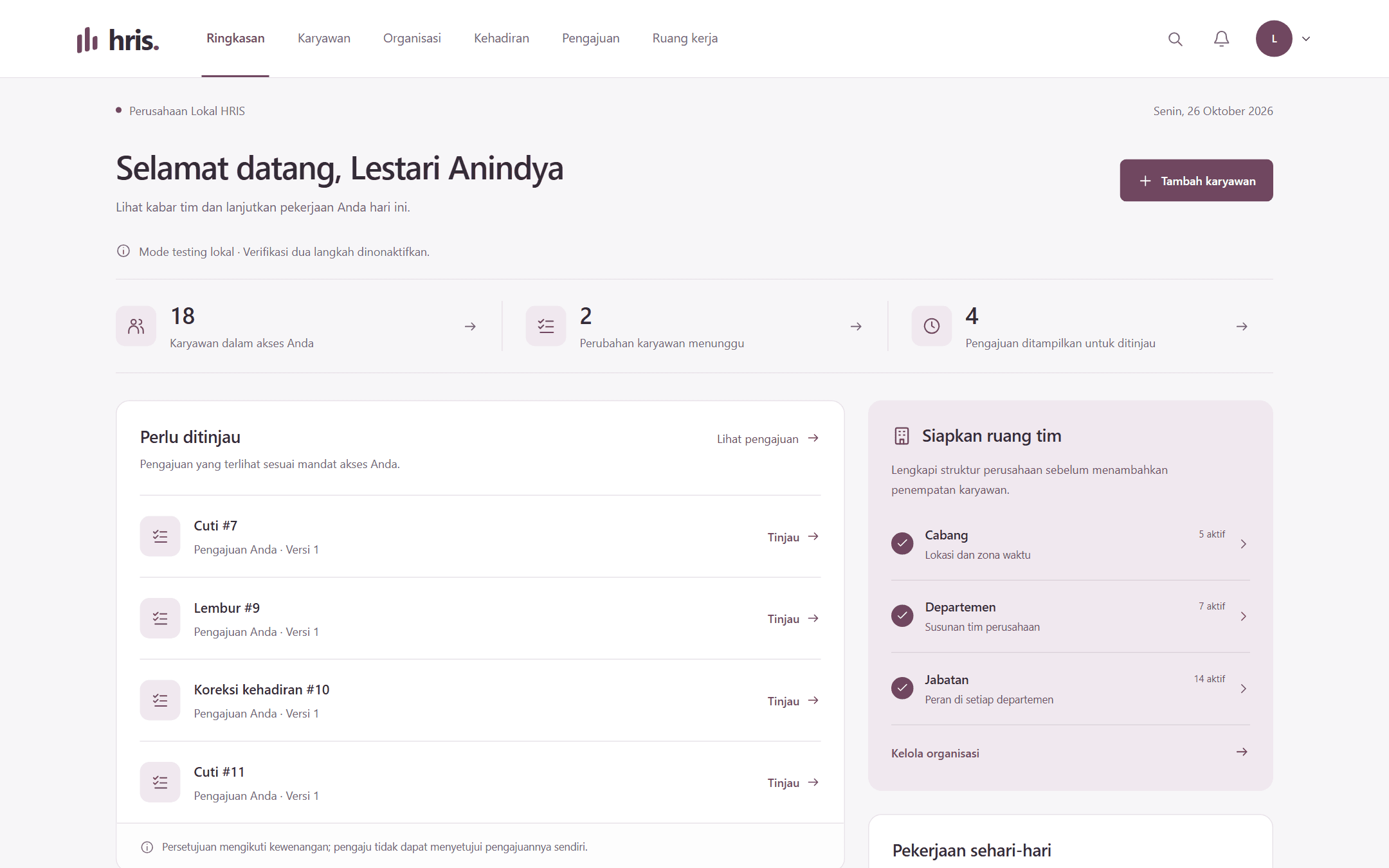
Integrated Operational HRIS is an enterprise-oriented human resource information system designed to handle complex organizational hierarchies and daily workforce operations. Built with Laravel 13, Livewire, and PostgreSQL, the platform provides audit-proof employee placement tracking, an independent 20-stage workflow engine with strict anti-self-approval rules, GPS/remote attendance recording, and scoped operational workspaces.
Project Overview
A full-featured operational HRIS platform that models real-world corporate governance. It replaces disjointed administrative spreadsheets with a centralized, auditable system covering employee directory management, organizational structures, shift scheduling, leave & overtime requests, document lifecycles, and scoped auditor reporting.
The Problem
Traditional internal HR systems often suffer from shallow data models—failing to track historical employee placement transitions, lacking atomic validation for overnight shifts and overlapping rosters, and leaving approval workflows vulnerable to unauthorized self-authorizations or race conditions.
The Solution
Engineered a robust, modular operational architecture on PostgreSQL and Laravel. The system enforces bi-temporal placement ranges, exclusion constraints preventing roster collisions, an idempotent multi-tier approval state machine, and mandatory multi-factor authentication (MFA) with row-level permission scopes.
System Architecture
Backend powered by Laravel 13 with Blade and Livewire 4 for reactive server-driven interfaces, styled using Tailwind CSS. The persistence layer utilizes PostgreSQL with specialized exclusion constraints and database triggers to ensure zero overlapping shifts and immutable audit logging. Built with an event-driven outbox pattern and queued background workers for batch imports and reporting.
Key Technical Challenges
Designing an atomic approval state machine capable of supporting 20 distinct workflow types while guaranteeing strict separation of duties (preventing self-approval) and handling complex cross-midnight shift schedules without concurrency race conditions.
Lessons Learned
Relying on database-level guarantees (such as PostgreSQL exclusion constraints and transactional row locks) is essential for mission-critical enterprise applications. Structuring approval policies into explicit, test-covered state transitions eliminates edge cases that typically plague multi-tenant administrative workflows.